On August 26, 2025, Google began rolling out a new spam update to its search algorithm. This global update, which will take a few weeks to complete, is designed to target websites that violate Google’s spam policies.
For website owners, understanding the purpose of this update and its potential impact is important for maintaining or improving search rankings.
What is the Google August 2025 Spam Update?
Google released the August 2025 Spam Update on August 26, 2025, at approximately 12 PM ET (or 9 AM Pacific Time)—its first spam update since December 2024 spam update and the first algorithm update of 2025 besides the June core update. Clarify this is a “normal spam update”, distinct from broader core updates, and is rolling out globally across all languages over the next few weeks.
It targets manipulative SEO and content tactics, such as:
- Auto-generated, duplicate, or thin content
- Keyword stuffing, cloaking, sneaky redirects, hidden text
- Link spam, scraped content, expired domain abuse, and site reputation abuse (sometimes via third-party content misuse)
Google’s AI-powered SpamBrain detection system continues evolving, capable of real-time spam identification, cross-domain pattern analysis, and content authenticity scoring.
This is an algorithmic update aimed at improving the quality of search results by penalizing sites that use manipulative or deceptive tactics. The update is a regular part of Google’s ongoing effort to combat spam and ensure a fair and useful search experience for users.
Unlike a core update, which is a broad change to Google’s ranking systems, this spam update is more narrowly focused on detecting and devaluing spammy content and behaviors.
Google Officially Announced:
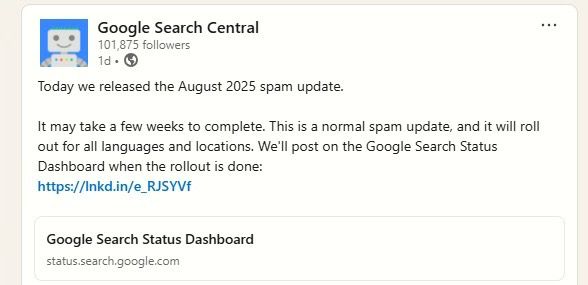
What Google Said in August 2025 Spam Update:
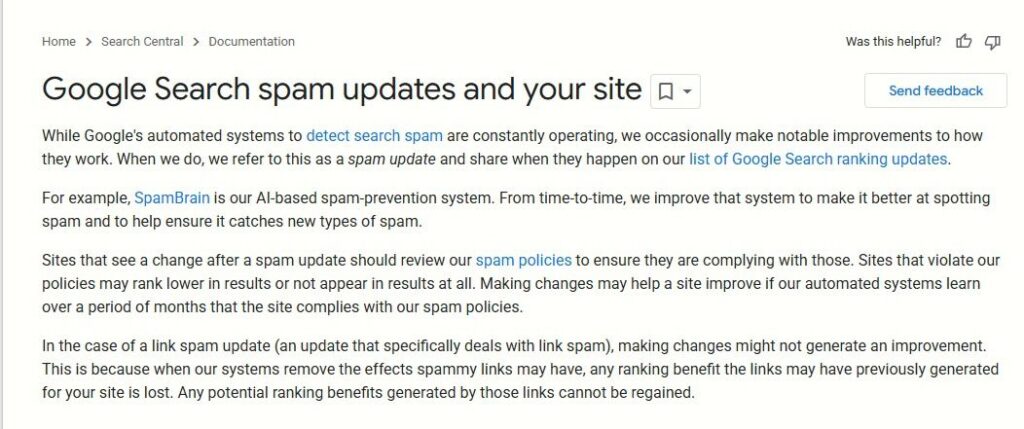
“While Google’s automated systems to detect search spam are constantly operating, we occasionally make notable improvements to how they work. When we do, we refer to this as a spam update and share when they happen on our list of Google Search ranking updates.
For example, SpamBrain is our AI-based spam-prevention system. From time-to-time, we improve that system to make it better at spotting spam and to help ensure it catches new types of spam.
Sites that see a change after a spam update should review our spam policies to ensure they are complying with those. Sites that violate our policies may rank lower in results or not appear in results at all. Making changes may help a site improve if our automated systems learn over a period of months that the site complies with our spam policies.
In the case of a link spam update (an update that specifically deals with link spam), making changes might not generate an improvement. This is because when our systems remove the effects spammy links may have, any ranking benefit the links may have previously generated for your site is lost. Any potential ranking benefits generated by those links cannot be regained.”
Why This Update Matters?
Longer gap: There was an 8-month gap since the last update—longer than usual—so this update likely is more comprehensive.
Signals Google’s intensified crackdown on low-value, manipulative content—especially with rising use of AI-generated articles.
E‑E‑A‑T (Experience, Expertise, Authoritativeness, Trustworthiness) and original, user-focused content are now more crucial than ever.
Which Websites Will Be Affected?
High-risk groups include:
- Affiliate-heavy sites with thin or auto-generated reviews
- AI content farms producing mass content without human oversight
- Parasite SEO setups and expired domains repurposed for ranking gain
- Low-quality directories or scraped aggregator sites
Google indicated link spam penalties are permanent—lost ranking benefits from manipulation cannot be regained, even after cleanup.
The update is specifically designed to affect websites that engage in practices that violate Google’s Spam Policies for Google Web Search. While the exact targets are not fully disclosed, the update likely focuses on a variety of spam techniques, including:
- Scaled Content Abuse: Producing a large amount of low-quality or unoriginal content, often using automation or AI, with the primary purpose of manipulating search rankings.
- Thin or Unhelpful Content: Pages with little to no value for the user.
- Hidden Text or Links: Using CSS, HTML, or other methods to hide text or links from users, but not from search engines.
- Keyword Stuffing: Overloading a page with keywords in an unnatural way to trick the algorithm.
- Aggressive Link Schemes: Manipulating a site’s ranking by buying or selling links, or engaging in excessive link exchanges.
What to Do if Your Website is Affected
If you notice a sudden drop in organic traffic or keyword rankings starting around August 26, 2025, your site may have been impacted. Here’s a detailed guide on what to do next.
- Don’t Panic and Wait: The update is still rolling out. Wait for the rollout to be officially completed (Google will announce it on their Search Status Dashboard). This will help you determine if the changes are temporary fluctuations or a lasting effect of the update.
- Conduct a Comprehensive Site Audit:
- Content Review: Be critical and objective. Look for content that offers little value, seems auto-generated, or is a copy of content from other sites. The best strategy is to create or improve content that is genuinely helpful, reliable, and user-focused.
- Spam Policy Review: Go through Google’s official spam policies. Identify any areas where your site might be out of compliance. Pay special attention to “Scaled Content Abuse” and any recent policies.
- Backlink Analysis: While this is not specifically a “link spam update,” a spam-focused update often works in conjunction with other systems. Check your backlink profile for any unnatural, low-quality, or manipulative links. If found, you can use the Google Disavow Tool.
- Focus on “People-First Content”: The best way to recover from any Google update is to stop focusing on the algorithm and start focusing on your users. Ask yourself these questions:
- Does my content provide real value to my audience?
- Is it original, and does it demonstrate expertise and trustworthiness?
- Is the user experience on my site good? Is it fast, mobile-friendly, and easy to navigate?
- Be Patient: Recovery from an algorithmic hit can take time. After you’ve made significant improvements, it may take weeks or even months for Google’s systems to re-evaluate your site. The next core or spam update may also offer an opportunity for recovery.
Monitoring & Diagnosis
- Track key metrics: Impressions, clicks, ranking positions via Google Search Console; label the update date for reference.
- Use tools like Ahrefs, Semrush, Google Analytics to identify patterns and assess impact.
- Avoid making sweeping changes mid-rollout—wait to evaluate consistent shifts.
Cleanup & Recovery
- Content Audit: Remove or improve thin, duplicate, or auto-generated pages.
- Backlink Review: Disavow toxic or manipulative links that could trigger spam signals.
- Technical Fixes: Eliminate cloaking, deceptive redirects, hidden text, keyword stuffing.
- Enhance Content Quality: Add author credentials, depth, original research, human oversight.
- Follow Spam Policies: Regularly audit your compliance with Google’s spam guidelines.
- Recovery may take weeks to months, depending on severity. Link spam may cause permanent ranking loss.
Tips for Prevention & Long-Term Best Practices
| Strategy | Description |
|---|---|
| Focus on E‑E‑A‑T | Demonstrate expertise, authority, credibility in content and authorship |
| Human + AI Collaboration | Use AI for drafts, but always add human editing and oversight |
| User-First Content | Create content that truly solves user needs, not just targets keywords |
| Natural Link Building | Earn links organically through value, not manipulation |
| Technical Hygiene | Ensure clean site structure, fast load times, mobile responsiveness |
| Ongoing Monitoring | Use analytics and dashboards to spot future fluctuations early |
Google August 2025 Spam Update: Your Quick-Fact Guide
Google has officially rolled out its latest algorithm refinement, and it’s all about fighting spam. Here’s a brief but comprehensive breakdown of what we know about the Google August 2025 Spam Update, distilled into bite-sized, actionable facts.
The Update’s Identity Card:
- Name: The “Google August 2025 Spam Update.”
- Launch Date: It began its journey on August 26, 2025, around 12:00 pm ET.
The Rollout and Scope:
- Duration: This isn’t an instant flick of a switch. The rollout is expected to take up to three weeks to fully propagate across Google’s systems worldwide.
- Global Reach: This update is not limited to a specific region. It’s a global operation, affecting all languages and locations.
What It’s After and What It’s Not:
- The Target: This update is laser-focused on websites that violate a number of Google’s core search spam policies. It’s an enhancement to Google’s automated systems (like SpamBrain) to catch new and evolving spam techniques.
- What’s Not Targeted: Interestingly, Google has specified that this update does not specifically target link spam or the recently introduced site reputation abuse policy. This indicates a focus on other forms of on-site and on-page spam.
The Impact and Path to Recovery:
- The Penalty: If your site is using techniques that go against Google’s spam policies, this update is designed to demote or penalize it. This can lead to a drop in organic rankings and traffic.
- The Big Question: When asked, Google did not disclose the percentage of queries or searches that would be impacted. This suggests the impact could vary widely across different industries and search result landscapes.
- How to Recover: The only prescribed remedy from Google is to carefully review and correct any violations of their spam policies. Google’s guidance is to get into compliance, as this will give your site the best chance to recover.
- The Recovery Timeline: Recovery is not immediate. Google stated that it can take many months for a site to see an improvement after corrections are made, as their systems need time to learn and reassess.
- Future Refreshes: This is not a one-and-done event. Google confirmed that it will conduct periodic refreshes to this spam update, continuously improving its detection capabilities.
SEO SEO Publishers Said: August 2025 Spam Update Targets AI Content and Fake Links.
Key Takeaways for a Sustainable Website
- Quality Over Quantity: Resist the temptation to create vast amounts of low-quality content. A few high-quality, in-depth articles will serve you better in the long run.
- Earn, Don’t Manipulate: Your rankings and links should be earned through the value you provide, not through manipulative schemes.
- Prioritize the User: The user’s experience and satisfaction are the ultimate goal of Google’s algorithms. A site that is genuinely helpful and easy to use is the most resilient against updates.
By focusing on these principles, you can ensure your website is not only compliant with Google’s guidelines but also built for long-term success. Contact White Hat SEO Specialist Prempal Singh for more consultancy at +91 7014165678.