
Google has officially started rolling out the May 2026 core update, and the SEO industry is already seeing major ranking volatility across multiple niches. From local businesses and SaaS companies to affiliate websites and publishers, many websites are experiencing significant traffic shifts.
According to Google, this is a “regular update designed to better surface relevant, satisfying content for searchers from all types of sites.”
But behind that simple statement lies a much bigger reality:
Search is evolving rapidly because of AI.
This is Google’s second core update of 2026. It follows the March 2026 core update, and then the March 2026 spam update
The Google core update May 2026 appears heavily aligned with:
- Helpful content evaluation
- AI search quality
- E-E-A-T signals
- User experience
- Topical authority
- Real expertise
- Trustworthiness
If your rankings changed recently, this guide will help you understand:
- What changed in the May 2026 core update
- Which websites were impacted
- Why Google is shifting toward AI-first search
- Recovery strategies that actually work
- How to future-proof your SEO in 2026
What Is the May 2026 Core Update?
The May 2026 core update is a broad algorithm update released by Google to improve the quality and relevance of search results globally.
Core updates are not penalties. Instead, they are broad changes to Google’s ranking systems that reassess how content should rank compared to other pages on the web.
Google explains core updates using a simple analogy:
Imagine creating a list of your favourite restaurants in 2019. Over time, new restaurants appear, old ones improve, and preferences change. Your updated list may rank restaurants differently, even if older restaurants are still good.
That is exactly how Google’s core updates work.
When Did the May 2026 Core Update Start?
Google officially confirmed the rollout of the Google core update May 2026 on May 21, 2026.
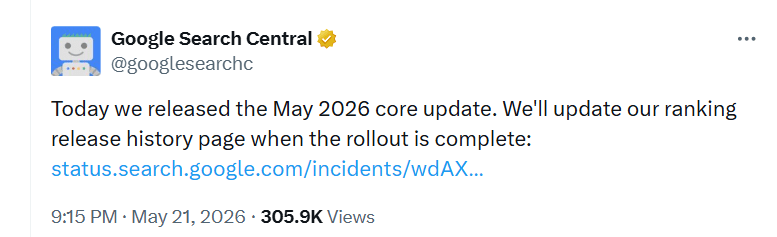
According to Google Search Central, the rollout may take up to two weeks to complete.
This makes it the second confirmed core update of 2026 after the March 2026 core update.
SEO tracking tools and industry discussions reported ranking volatility even before the official announcement, suggesting Google may have been testing ranking changes earlier in May.
Why Google Released This Update
Search behaviour has fundamentally changed.
Users increasingly rely on:
- AI-generated summaries
- Conversational search
- Voice search
- AI Overviews
- Zero-click results
At the same time, the internet has been flooded with low-quality AI-generated content.
Google appears determined to improve content quality before AI search becomes the dominant search experience.
Recent policy updates also show Google targeting attempts to manipulate AI-generated search responses. Google updated its spam policies to explicitly prohibit manipulating AI search systems and AI-generated responses.
This signals an important shift:
SEO is no longer just about ranking webpages.
It is now about becoming a trusted source for both traditional search and AI-generated search experiences.
Key Changes in the May 2026 Core Update
1. Experience-Based Content Matters More
Google continues prioritising content written from real-world experience.
Websites showing:
- Case studies
- Original screenshots
- Industry expertise
- First-hand testing
- Client examples
- Personal insights
are outperforming generic AI-generated pages.
Example
A cybersecurity company publishing real penetration testing findings will likely outperform a generic “What is VAPT?” article rewritten from competitor blogs.
2. AI-Generated Thin Content Is Losing Visibility
Google has repeatedly stated that AI content itself is not against the guidelines.
However, low-value AI content is clearly struggling after the May 2026 core update.
Common patterns among declining websites include:
- Repetitive AI phrasing
- Generic introductions
- Surface-level explanations
- Lack of originality
- No expert validation
- Scaled content publishing
This aligns with Google’s broader “helpful content” direction now integrated into core systems.
3. Topical Authority Became Stronger
Publishing hundreds of unrelated blogs no longer works effectively.
Google increasingly rewards websites with deep expertise in focused subjects.
Winning Strategy in 2026
Instead of covering everything, successful websites are building topic clusters.
Example:
An SEO agency covering:
- Technical SEO
- AI SEO
- Google updates
- Local SEO
- Content optimization
- SEO audits
is more likely to rank consistently than a general marketing blog covering random topics.
4. User Experience Signals Appear Stronger
Many affected websites share UX problems, such as:
- Excessive ads
- Slow loading pages
- Poor mobile experience
- Clickbait titles
- Aggressive popups
- Weak navigation
Google continues to emphasise user satisfaction as a ranking factor.
5. AI Search Optimisation Is Becoming Essential
Google Search is rapidly evolving into an AI-powered experience.
At Google I/O 2026, Google introduced major AI search upgrades, including interactive AI search experiences, AI-generated summaries, and conversational search enhancements.
This means SEO content must now optimise for:
- AI Overviews
- Conversational queries
- Entity recognition
- Structured answers
- Semantic relevance
Traditional keyword stuffing is becoming obsolete.
Industries Most Affected by the Google Core Update May 2026
Industries Seeing Positive Growth
SaaS Companies
High-quality educational content performed well.
Cybersecurity Websites
Technical expertise and trust signals helped many cybersecurity brands gain visibility.
Local Service Businesses
Businesses with strong reputation signals and authentic reviews improved rankings.
Health and Medical Sites
Verified expertise remains critical for YMYL industries.
Industries Seeing Declines
AI Content Farms
Mass-produced AI blogs lost visibility.
Thin Affiliate Websites
Sites created purely for monetisation struggled significantly.
Generic News Aggregators
Rewritten news content without unique reporting declined.
Expired Domain SEO Networks
Manipulative SEO strategies continue losing effectiveness.
What Google Officially Says About Core Updates
Google’s official documentation contains several important insights website owners should understand.
Core Updates Are Broad
Google states core updates are broad ranking improvements and do not target individual websites.
Ranking Drops Are Not Penalties
A ranking decline after a core update does not necessarily mean your content is bad.
Often, other pages are simply considered more useful.
Recovery Takes Time
Google recommends focusing on improving content quality rather than searching for “quick fixes.”
Helpful Content Is Central
Google’s ranking systems increasingly reward people-first content.
Signs Your Website Was Hit by the May 2026 Core Update
You may have been impacted if you noticed:
- Sudden ranking drops
- Traffic declines across multiple pages
- Lower impressions in Search Console
- Featured snippet losses
- Increased SERP volatility
- Reduced Discover visibility
However, avoid making panic changes immediately.
Google specifically recommends waiting until the rollout fully completes before analysing performance.
How AI Search Is Reshaping SEO in 2026
The rise of AI search may be the biggest SEO transformation since mobile-first indexing.
Google’s AI systems increasingly answer informational queries directly within search results.
As a result:
- Generic informational pages may receive fewer clicks
- Unique expertise matters more
- Brand trust is becoming critical
- Structured content performs better
Content That Still Wins
- Original research
- Expert opinions
- Industry data
- Tutorials
- Case studies
- Experience-based insights
Content Losing Traffic
- Generic definitions
- Rewritten articles
- Mass AI content
- Thin affiliate pages
- Keyword-stuffed blogs
Recovery Plan After the May 2026 Core Update
If your rankings dropped, focus on long-term quality improvements.
Step 1: Audit Thin Content
Identify pages with:
- Low engagement
- Weak originality
- Outdated information
- Duplicate intent
Improve, merge, or remove them.
Step 2: Strengthen E-E-A-T Signals
Add:
- Author bios
- Credentials
- Company details
- Testimonials
- Real examples
- Case studies
Trust matters more than ever.
Step 3: Improve Topical Depth
Create supporting content around core topics.
Example cluster:
- Technical SEO
- Core Web Vitals
- AI SEO
- Google updates
- Search Console guides
This builds authority.
Step 4: Update Old Content
Refresh:
- Statistics
- Screenshots
- Internal links
- Examples
- FAQs
Freshness remains important.
Step 5: Optimise for AI Search
Structure content clearly using:
- Definitions
- Bullet points
- Tables
- FAQs
- Concise summaries
AI systems prefer easily extractable information.
Comparison Table: Traditional SEO vs SEO After the May 2026 Core Update
| SEO Before 2026 | SEO After the May 2026 Core Update |
|---|---|
| Keyword stuffing | Intent-focused optimization |
| Quantity publishing | Quality publishing |
| AI mass content | Expert-reviewed content |
| Link quantity focus | Authority and trust focus |
| Thin affiliate pages | Helpful content hubs |
| Generic articles | Experience-driven content |
| Traffic-first mindset | User satisfaction mindset |
| Anonymous publishing | Brand authority building |
Also Read: Old SEO vs New SEO Strategies: How SEO Changed in 2026?
Expert SEO Tips for 2026
Build a Recognisable Brand
Brand searches increasingly act as trust signals.
Publish Original Insights
Unique data helps earn links and AI citations.
Demonstrate Real Expertise
Share implementation experience, not just theory.
Improve UX Aggressively
User engagement affects rankings more than many SEOs realise.
Diversify Traffic Sources
Do not rely solely on Google traffic.
Use:
- YouTube
- Email marketing
- Communities
- Podcasts
Common SEO Mistakes After the Google Core Update May 2026
Publishing Unedited AI Content
AI-generated drafts require expert review.
Ignoring Technical SEO
Crawlability and performance still matter.
Creating Multiple Pages for the Same Intent
Keyword cannibalisation remains a major issue.
Chasing Every Trend
Focus on building authority within your expertise.
Overusing Exact Match Keywords
Natural language optimisation works better.
Benefits of Adapting Early to the May 2026 Core Update
Better Ranking Stability
Quality websites survive future updates more easily.
Higher Conversion Rates
Helpful content builds trust and improves leads.
Stronger Brand Authority
Authority compounds over time.
Better AI Visibility
Structured expert content is more likely to appear in AI-generated answers.
Long-Term SEO Sustainability
People-first SEO is future-proof SEO.
Frequently Asked Questions
What is the May 2026 core update?
The May 2026 core update is a broad Google algorithm update focused on improving content relevance, trustworthiness, and user satisfaction.
When did the Google core update May 2026 start?
Google officially began rolling out the update on May 21, 2026.
How long will the May 2026 core update take?
Google stated the rollout may take up to two weeks.
Does the May 2026 core update target AI content?
Not directly. Google targets low-quality, unhelpful, and unoriginal content regardless of how it was created.
Can rankings recover after a core update?
Yes. Google confirms websites can recover after improving overall content quality and relevance.
What type of content ranks best after the May 2026 core update?
Experience-driven, expert-led, deeply helpful, and trustworthy content performs best.
Is E-E-A-T important after the May 2026 core update?
Yes. Experience, Expertise, Authoritativeness, and Trustworthiness are increasingly important ranking factors.
Are AI Overviews reducing organic traffic?
Yes. Informational searches increasingly receive direct AI-generated answers within search results.
Should I remove AI-written content?
Not necessarily. Improve low-quality pages with human expertise, originality, and better structure.
What should I do first after losing rankings?
Wait until the rollout completes, then audit content quality, search intent alignment, and user experience.
Conclusion
The May 2026 core update confirms that Google is accelerating toward a more AI-driven, quality-focused search ecosystem.
SEO in 2026 is no longer about producing the highest number of pages or manipulating rankings with shortcuts.
Google increasingly rewards:
- Real expertise
- Helpful content
- Trustworthiness
- Brand authority
- User satisfaction
- Experience-driven insights
The websites that succeed after the Google core update May 2026 will be those that genuinely help users rather than simply trying to rank.
The future of SEO belongs to trusted brands, expert creators, and businesses willing to prioritise quality over scale.
Take Experts’ Help
If your website lost rankings after the May 2026 core update, now is the perfect time to strengthen your SEO strategy.
At Prempal Singh SEO, we help businesses recover traffic, improve rankings, and build AI-ready SEO systems designed for modern search engines.
Our services include:
- Technical SEO audits
- AI SEO optimization
- Content strategy
- Google update recovery
- Local SEO
- Enterprise SEO consulting
Contact us today to build a future-proof SEO strategy that survives every Google update.