Suppose you have invested a lot of time into building a great website with awesome content, yet almost no one can find it. Frustrating, right?
Before On-Page SEO, This is where Technical SEO comes into the picture to do the miracle. It is like ensuring that once you build your home, it has a good structure that both search engines and other users can follow so that when you type your website’s name, it will appear on the list.
Imagine that Technical SEO is the unseen workforce that ensures that everything is going according to the plan. It’s what assists search engines in crawling your site, its compliance with the speed and ease of navigation, as well as its readiness for higher positions.
Rather, one is getting the feel of Technical SEO depending on whether you own the business and want more traffic or just a simple website owner. Well, that’s enough of the basics and now comes the real fun part, how to get the attention of the right audience to your site!
Understanding Technical SEO: The Backbone of Website Optimization
Technical SEO is about improving your website to make it easier for search engines to discover, index, and store your content.
In the process of Technical SEO, we ensure that a website meets the technical requirements of search engines with the goal of improved organic ranking.
Several actions occur behind the scenes, which play a crucial role in increasing the site’s popularity, making it accessible to visitors with maximum convenience, and achieving the highest rankings in search engines.
Technical SEO differs from other SEO techniques since it does not target the content but the framework that comes with it. These factors include site speed, the site’s ability to load properly on a mobile device, its architecture, and its security, among others.
As applied, Technical SEO helps to optimize website functionality and guarantee search engines’ ability to read and rank your content.
Why Is Technical SEO Important?
Technical SEO is important since it forms the foundation of a website’s good or bad SEO status. That is why even high-quality content may never reach its target user if it has not been technically optimized.
Here’s why:
1. Search Engine Accessibility: This is not surprising since if the search engines cannot crawl or index your site, your content might as well not exist, even if you churn out high-quality content.
2. User Experience: Other factors, like page speed and mobile friendliness, clearly indicate how users will interact with the website. Slow website processing deters users due to high bounce rates, which, in turn, has adverse effects on the rankings.
3. Ranking Factors: These are some technical SEO factors that Google and other search engines utilize to rank sites. For instance, HTTPS is a recognised ranking factor, while Mobile usability is a necessity because Google has implemented Mobile-first indexing.
The Basics of Technical SEO
To understand Technical SEO better, let’s break down some fundamental concepts and best practices:
1. Crawling and Indexing
Crawling refers to the process through which search engines identify your pages, and indexing is how such details are stored and made easily accessible for display in the search engine’s result pages.
• Site Architecture: A good example of such design is that all site pages are to be no more than three mouse clicks away from the home page. This benefits not only the users but also crawl-bots, which are search engine web crawlers, efficiently.
• Sitemap Submission: An XML sitemap is a list of all the essential pages on a certain website to help the search engine identify the content to index. You cannot afford to be complacent without submitting your sitemap through the Google search console. You can generate a sitemap using xml-sitemaps.com or sitemaps.org.
• Robots. txt: This file explains to the search engine which part of your site is undesired or they don’t want to crawl. It is also very important to note that while limiting the crawl of which pages is a necessity, do not close off the wrong page. You can generate robots.txt files using www.seoptimer.com/robots-txt-generator.
| Element | Purpose |
| XML Sitemap | Helps search engines discover and index your important pages |
| Robots.txt | Instructs search engines on which pages or sections of your site should not be crawled |
2. Mobile-Friendliness
With the new update, Google made mobile-first its new standard. The focus is now on the mobile version of any site. Due to technological changes, your site must be mobile-friendly.
• Responsive Design: A responsive website is designed so that it will have to be rearranged depending on the screen size of the device used to access the site. This ensures that the user interface has similar functionality regardless of the type of device used.
• Page Speed: Audiences that are mostly mobile device users, like mobile applications, expect a web page to load faster. Google page speed insights, for example, provide clues that can assist you in diagnosing problems that slow down your site.
3. HTTPS and Security
HTTP (Hypertext Transfer Protocol) mainly has two forms, HTTP and HTTPS, where HTTPS is a secure version of HTTP and is very important for protecting user data. Since 2014, it has been a confirmed ranking signal, but it is still an essential factor.
• SSL/TLS Certificates: These certificates assign secured keys to the data exchanged between the user’s web browser and your website, providing privacy. Thus, if your site still accesses content through HTTP, it is high time you shifted to HTTPS.
• Security Headers: Security headers should also enhance your site’s security against attacks such as XSS and clickjacking.
4. Duplicate Content
This situation is where more than a single URL with the same or related content exists. This can mislead the search engines,, and the ability to rank a site is compromised.
• Canonical Tags: Use the call meta tag to tell Google which version of the page is the default. This helps build link equity and avoid duplicate content issues.
• 301 Redirects: If you have multiple URLs containing similar content, then work on the process of redirecting all the traffic to a preferred URL.
Issue | Solution |
| Duplicate Content | Use canonical tags or 301 redirects to consolidate content and link equity |
| HTTP vs. HTTPS | Ensure your entire site uses HTTPS and redirects HTTP traffic to HTTPS |
Also Read: On-Page SEO: What It Is and How to Do It?
Technical SEO Checklist
Beyond the basics, here are some advanced best practices to further optimise your site’s Technical SEO:
1. Structured Data
Structured data, or schema markup, as it is sometimes called, assists search engines by giving added meaning to the content on your website.
- Rich Snippets: Structured data can lead to rich snippets, which are enhanced search results that contain information such as review ratings. Schema markup makes the results look more attractive and informative to the users, thus enhancing CTR.
- JSON-LD: This is the most recommended way of adding structured data to/within your HTML. CAPTCHA is very easy to integrate and does not overlay the site content of your Web page.
2. Optimizing Core Web Vitals
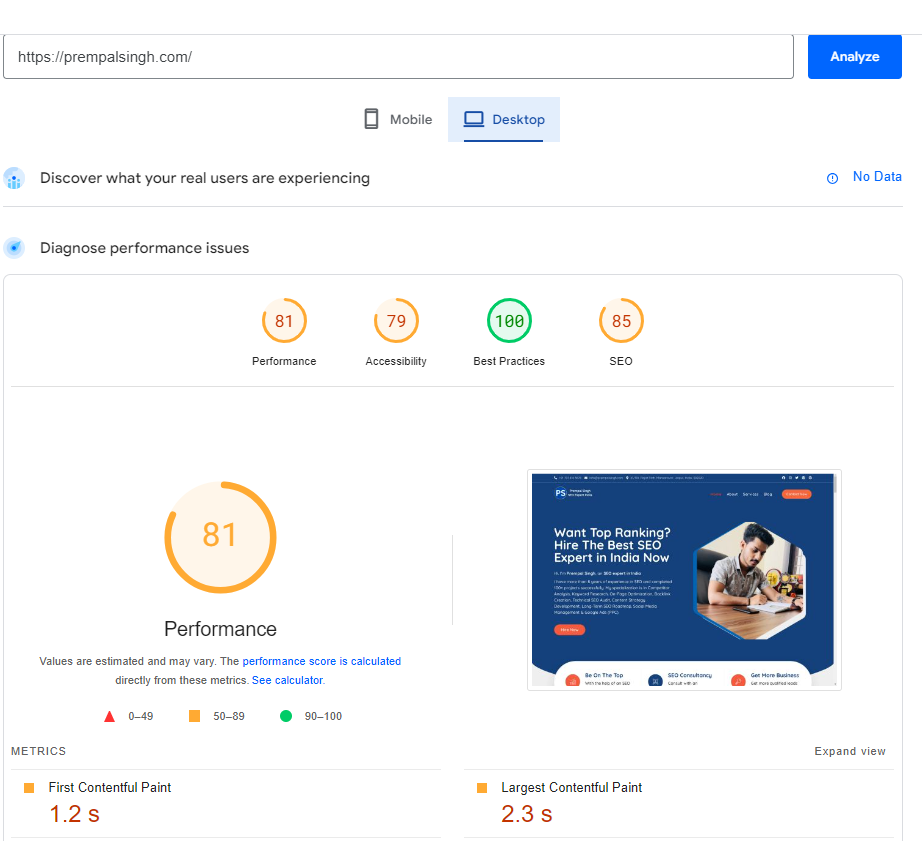
Core Web Vitals are a subset of the user experience metrics that are speed-related, and Key Experience Signals are essential in the set of factors affecting the overall User Interface.
• Largest Contentful Paint (LCP): This metric represents the time it takes for the most important element of any webpage to load. The appropriate value for LCP should be 2. 5 seconds or less.
• First Input Delay (FID): This determines the time that elapses before the page responds to interaction. Ideally, the FID shall be below 100 ms.
• Cumulative Layout Shift (CLS): This determines your page’s visual stability or how constant the content is from viewer to viewer. Ideally, the CLS should be less than 0. 1.
You can check webpage speed and core web vitals report at Google’s Page Speed Tool.
3. Pagination and Infinite Scroll
If the site contains a lot of content, for example, a blog or online store, pagination is important. Crawling and indexing are affected because search engines do not know when they can start and will stop crawling, as well as users’ inability to scan through pages.
• Implementing Pagination: To help search engines understand paginated pages, use tag rel=” next” and tag rel=” prev” to define the paginated page relationship.
• Avoid Infinite Scroll: If your site employs an infinite scroll, make sure that search engines can scan all the content, maybe by using a sequence of paginated URLs.
Also Read: How to Recover Your Website’s Google Ranking: A Comprehensive Guide
Conclusion
Technical SEO provides the basis of almost any good SEO plan and approach. By serving the aspects of the site concerning creeping, indexing, mobile friendly, and security, you ensure your content is always visible and searchable by the search engine.
Leveraging best practices for Technical SEO increases your visibility within search results while improving your site’s usability for visitors, which in turn increases overall satisfaction among site users.
Keep in mind that Technical SEO is a never-ending process. Updating one’s website with current practices, making changes where there has been a shift in ranking-based algorithms, and generally auditing one’s website is crucial for retaining and enhancing the site’s status.
When you focus on Technical SEO, you set the right groundwork for all the other SEO activities you will perform well in the future to thrive in the saturated digital world.
Technical SEO FAQs
1. What is Technical SEO?
Technical SEO is the process of ensuring that website elements are properly optimized to improve search engine rankings.
2. What are the uses of Technical SEO?
Technical SEO allows search engine crawlers to access, index, and interpret your website about the rankings you wish to achieve.
3. What are the Core Web Vitals in New Technical SEO?
Therefore, Core Web Vitals are vital user experience measuring tools crucial for technical SEO, they depend on the page’s speed, interactivity, and visual stability.
4. What is the role of the sitemap in Technical SEO?
A sitemap assists search engines in crawling and indexing all the relevant pages on your website, thereby bolstering Technical SEO.
5. What is the role of HTTPS in Technical SEO?
HTTPS protects your website and is considered a factor in Technical SEO. This, in a way, influences trust from both users and search engines.