On looking over the key areas of search engine optimization, On-page SEO turns out to be a cornerstone in the world of emerging concepts of digitalization in several different business and service sectors. Moreover, it checks for the elements involved in optimizing the work of a particular website to improve its search engine performance and the overall user experience.
Let us discuss and develop an in-depth knowledge of On-Page SEO to improve the search engine rankings of your website.
What is On-Page SEO?
On-page SEO (also known as “on-site SEO”) is the practice of optimizing a website’s pages to enhance their visibility in search engines and optimizing content for users.
An On-page SEO can be addressed as a practice concerned with optimizing the website pages of many individuals to rank up as well as to gather more relevant traffic on their search engines in masses. Moreover, it encompasses a wide variety of strategies and an efficient set of techniques that aims at improvising the overall content, structure, functions, knowledge, and HTML code of the concerned pages of a user. Its main objective is to make a website more search engine friendly by simultaneously delivering an experience like never before to the associative audiences.
Why is On-Page SEO important?
An on-page SEO facilitates search engines in evaluating the rankings of a website as well as its related content, including its connection in terms of user query. It checks the relevance of a particular content considering user preferences or search patterns. However, Google is consecutively making efforts in the direction of updating their algorithms to adhere to a better understanding of the needs or preferences of the users to present the best-suited content in front of their eyes. This is in turn helpful for you to develop a niche and understand your target audiences thoroughly. Additionally, it is important to increase the visibility of your website over the global Internet networks.
On-Page SEO vs. Off-Page SEO
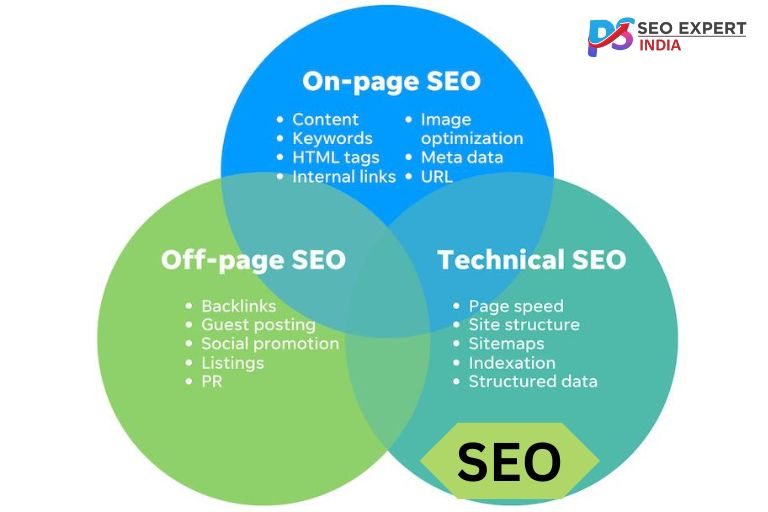
Before jumping to any conclusions about which of them is better, let us understand both of these concepts in terms of their relevance to search engines. On-page SEO is mostly concerned with involving ways to directly improve the website structure and content for the user to increase their search engine rankings. Whereas, Off-Page SEO is responsible for handling the external factors that may directly or indirectly affect the overall website functioning along with its ranking and authority. Moreover, On-Page SEO adheres to major components such as Quality and Relevance of the Content, Title tags and Meta Descriptions, Heads and sub-heads, Structure of URL, Image Optimization, Page Speed, Mobile Optimization, Internal Linking, and User Experience. On the other hand, Off-page SEO consists of Backlinks, Local SEO, Influencer Outreach, Social Media Engagement, Reputation Management Online, and at last, the Marketing part of your website content.
However, the major difference between them lies in their focus areas and control, impacting their overall ranking on the Internet. In this light, an On-Page SEO thoroughly focuses on mere optimization, which checks the elements present within the website. Along with this, it provides direct control over the efforts concerned with the process of optimizing as well as its implementation function. On the contrary, Off-Page SEO majorly keeps its eyes on the external factors and actions that need to be taken into consideration from outside of the website. Moreover, it extensively relies on external sources and interactions in consideration of less predictable as well as more challenging to manage.
Therefore, using On-Page SEO is often advisable to generate more traffic and improve SEO rankings so far. This can be also due to the ever-changing nature as well as unpredictability at the core in terms of Off-page SEO. In addition, opting for On-Page SEO, by using specific keywords to adhere to the relevance and usability of the content present on a particular website can also enhance your user engagement. That’s why, it is considerably the most essential of the two.
Also Read: Top 10 SEO Freelancers to Hire in India
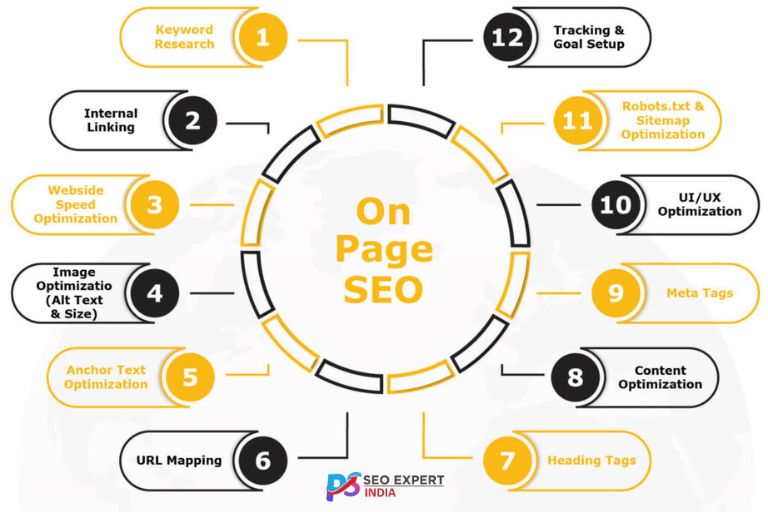
Key Components of On-Page SEO
Here, are some of the most significant components of On-Page SEO presented below:
• Title Tags:
These are the most crucial elements of On-Page SEO. it usually appears in the search engine results pages, commonly known as SERPs like a clickable headline for a given result. In consideration of this, for a well-crafted title tag, one must focus on creating a compelling title by using action-oriented language to facilitate the number of users in quickly analyzing their requirements concerned with the website. Moreover, including primary keywords, keeping a limit of 50-60 characters for the title and correct branding may help the website to attract more traffic.
• Meta Descriptions:
Secondly, the meta descriptions are held responsible for providing a summary of the content on your page as well as a title tag would appear in the SERPs. These are themselves not a direct ranking factor, they are mostly concerned with influencing click-through rates. However, to optimize your meta descriptions, you must incorporate relevant keywords, and create a compelling summary/abstract to enhance user interest in your content. This will also help them to stay on your website for a much longer period. Moreover, limiting the characters of this description or summary to 160 characters would be enough for a reader to get an understanding of the information present in the blog or article. Along with this, don’t forget to add a line describing your call to action regarding the subject matter.
• Headings (H1, H2, H3, etc.):
Likewise, headings are the most significant component of On-Page SEO. It helps a user to build a structure of website content as well as makes it much easier for them and the search engines to thoroughly understand the hierarchy of the information present on the page. However, it is advisable to use H1 for the main headings, H2 for the sub-headings, and H3 & so on for the further divisions. Organizing the content in such a way would help you to maintain the content’s relevance and its clear visibility to its users.
• URL Structure:
A clear and well-descriptive URL structure improves user experience as well as aids in search engine indexing. There are some of the best practices associated with it such as the incorporation of excellent and relevant keywords, keeping URLs short and descriptive as well as using hyphens to separate words, highlighting them to create a new trend of words.
• Content Optimization:
Content optimization is required to provide high-quality content to the users. Prioritizing good quality content may attract huge sums of visitors to your website to site your rank in a better and more effective way. However, certain strategies might help in optimizing your content for better use and sustainable traffic generation. These might include Undertaking thorough keyword research, creating high-quality content with good but not complex language, avoiding using jargon, trying to opt for a niche, optimizing content by its readability as well as including multimedia such as infographics, images, videos, and animations.
Impact of On-Page SEO on Search Engine Rankings
On-page SEO serves as a critical element in directly affecting how search engines develop an understanding of a web page as well as analyze it thoroughly to measure the positives and shortcomings prevailing in the content. It is a foundational element in achieving higher search engine rankings. By rightly focusing on optimizing the content, URLs, meta tags, internal links, header tags, multimedia, page speed, and mobile friendliness, these websites may undergo several functions. This practice may lead a website to the following impacts:
• Improves Relevance:
A fully optimized web page is more likely to be considered relevant in terms of the audience’s search queries, which leads to higher rankings for the keywords that have been targeted well addressing the most user information needs.
• Enhancing the User Experience:
On-page SEO practices like these contribute to a more positive user experience, leading to more satisfied target audiences. These are further recognized by the search engines in terms of rewarding them with better rankings.
• Boosting Page Authorities:
Effective internal linking and content optimization may help to distribute the authority in the entire website as well as automatically improve the ranking potential of numerous pages.
Also Read: SEO Freelancer or SEO Company. Who to Entrust Website Promotion?
Some of the On-Page SEO techniques to cater to your website needs are presented below—
• Schema Markup:
It is a type of structured data that helps search engines grasp the knowledge of the content present on your web page and display rich snippets in the search results. Using free tools such as Google’s Structured Data Testing to ensure the effective implementation of the markup is necessary.
• User Experience (UX) and Engagement:
To influence the engagement of users as well as to reduce their bounce rates, this technique may prove to be beneficial for creating an indirect positive influence on them.
• Mobile Friendliness:
On looking at the increased usage of mobile devices, the creation of mobile-friendly websites is essential to reach more sums of readers.
• Page Speed:
It is the highest-ranking factor that affects user experience and is duly responsible for major bounce rates. Slower loading pages may lead to lower rankings.
• Internal Linking:
Internal Links connect different pages of your website, facilitating users to navigate and distribute page authorities. Moreover, it is a great source for increasing user engagement and the time spent on your concerned website.
• Image Optimization:
Pictures glorify the experience of the users to better understand the content, using relevant images in your content is always a good idea.
• Enhance Readability:
Consider breaking down some of the longer sentences or paragraphs to improve readability. This can make the text more engaging and easier to follow for readers who may be new to the concept of On-Page SEO.
• Add Visual Aids:
Integrate relevant visuals such as sketches, charts, or infographics to complement the text. Visual aids can help illustrate key concepts and make the content more engaging and understandable.
• Include Concrete Examples:
Incorporate specific examples, and case studies for demonstrating the practical application of On-Page SEO strategies. This can help readers better understand how these strategies work in real-world scenarios.
Conclusion
In conclusion, it can be well observed that On-Page SEO is one of the essential components of search engine optimization. It is comprised of several benefits for the content providers and the users. This majorly works well in the direction of ensuring more visibility and relevance of the website and its content to the concerned users. Moreover, it adheres to a wide range of SEO techniques to improve the chances of getting higher ranks in the search engines comprised of the large global networks of the Internet. Additionally, a continuous evaluation as well as the refinement of these techniques may help to maintain and increase the website’s performance over some time. Hire an SEO expert if you are facing issues with On-Page SEO.