
What is Local SEO?
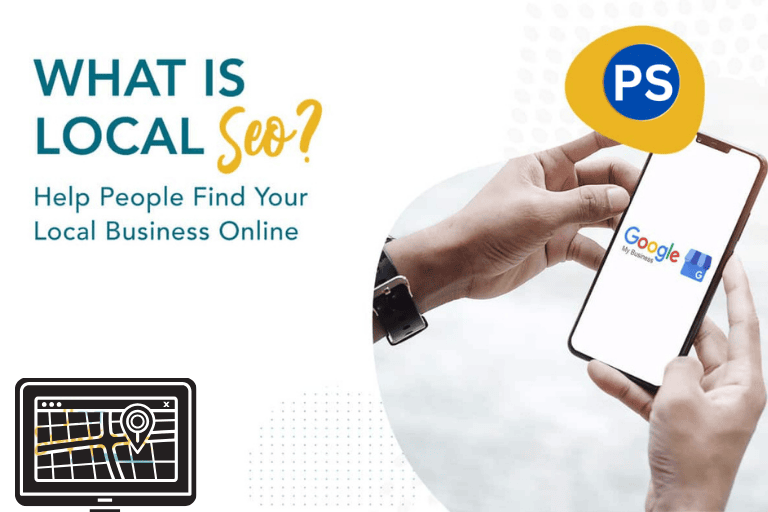
Are you a small business wishing to get more customers from your local area? Local SEO (Search Engine Optimization) is a powerful marketing strategy that you can adopt.
Local SEO is an SEO and digital marketing strategy and a set of techniques that help your business be more visible in location-based or local search results on Google Search and other engines. Local search is powerful for every small business as it helps you optimize your website to rank higher in search results so that you can reach your local audience.
If your business is not optimized for local search, you may miss out on potential customers who are ready to shop in your area. 46% of Google searches search for local information and facts. Local SEO is imperative if you want your business to stay relevant. By optimizing for your address and city, you help people find your business online so that they can visit it offline.
Why is Local SEO important?
Local SEO is critical as many people use search engines to find various local businesses. It is an effective way to market your company online when you wish to bring more people to your area and your store. So, your business needs to have quite an effective local SEO strategy to ensure your company appears among the top results when your potential customers look for products or services online. It is an essential process for businesses aiming at increasing brand awareness, leads, and localized traffic.
Let’s have a look at the statistics.
- 78% of people who search for something nearby on their mobile devices tend to visit the business within a day.
- 30% of all mobile searches have a relation with the location.
- 28% of searches for something “near me” result in a purchase.
- Near me searches have increased over 500% in the last few years
- There has been an increase of 200% for phrases such as “open near me now”
How Local SEO Works
Local SEO works by assisting Google understand the location of your business and what product or service it offers. It also helps Google perceive your business as more trustworthy or popular. When ranking businesses in the local pack and Google Maps, Google considers-
- Distance: How far is the search location from the business location?
- Relevance: How well does the business match what the audience is searching for?
- Prominence: How well-reviewed or well-known is the business?
When ranking web pages in search results, Google considers-
- Usability: How strong the performance of your webpage is based on mobile-friendliness or speed?
- Quality: How trustworthy or helpful the content is?
- Relevance: How well do your web pages match the matter that the user is looking for?
Local SEO Tips: Optimize your site for local searches
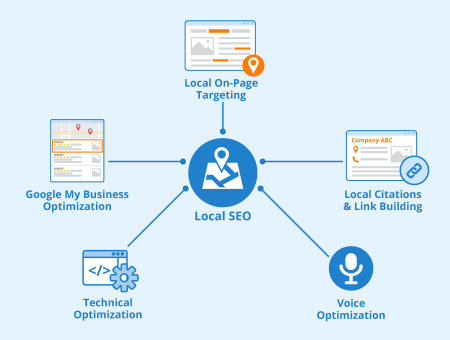
It is now time to create a plan to boost traffic by increasing your local rankings. The following tips will help you.
- Optimize for Google My Business
Since Google verifies, shares, and supports its own content open-handedly, Google My Business is quite an ideal tool to help businesses meet the needs of Google. To ensure you are optimized for Google My Business, you can create a Google My Business page and verify it, encourage your customers to share online reviews, use Google Posts in your account, and respond to reviews, specifying location authentically.
- Engage on social media
Lately, Google considers content that is shared on social media more important. After carving a beautiful Google My Business page, you need to share it on social media, aligning social and search further.
- Ensure your name, phone number, and address are consistent online
You need to make it easy for search engines and people to find you. For this, you need to set your NAP (Name, address, and phone number). Your NAP has to be considered crawlable HTML text on your website for Google to display it better as per location-based search results.
- Optimize online citations and directories
Consistency is key. Discrepancies like wrong phone number, lack of suite number, abbreviations, and misspellings can be problematic.
- Perform a local SEO audit
A local SEO audit includes the following-
- Google My Business Audit
- Social Media Audit
- Google Search Console Audit
- Website Audit
- On-Page SEO Audit
- Citation Audit
- Competitor Analysis
- Improve internal linking structure
Internal linking supports website navigation, distributes ranking power and page authority among pages, and assists with website hierarchy and information architecture.
- Optimize URL, content, meta descriptions, headers, and title tags
Every time you are writing a piece of content, you have to optimize it for search engines by using high-volume keywords on the URL, body, meta description, deader, and title. Consider highlighting case studies and customer success stories.
- Add location pages to your website
Create location pages if you have more than one brick-and-mortar location. This provides readers with your name, phone number, address, promotions, transit/parking information, unique store descriptions, and testimonials from happy customers.
- Create local content
You have to be the local authority for your specified industry and you can do so by promoting industry gatherings, employees, news, and educational content on your blog. You need to think of top-of-the-funnel content that goes much beyond what your business sells.
- Make sure that your website is mobile-friendly
61% of all Google searches are done on mobile and since 2017, the “near me” searches have increased 250%. In a mobile environment, people will use your site to search for contact information, find directions to reach your location and look up reviews.
Local SEO Tools
Let’s look into some practical SEO tools that you can leverage to improve your business ranking in the areas where it matters most.
- Semrush’s Listing Management
- Semrush’s Positioning Tracking
- Whitespark Local Citation Finder
- Google Search Console
- Screaming Frog
- Moz Local
- Ahrefs
- Buzzstream
- BrightLocal
In Conclusion,
Local SEO is a critical part of any SEO strategy for local businesses. It will help your audience find you when they are searching online if you have a service area or a storefront. Improve your business visibility with the local SEO services from Prempal Singh, one of the best SEO experts in India. Prempal Singh optimizes local search results through GMB and various other techniques. I hope this blog is helpful in your SEO journey to gain brand authority and recognition on the net.